
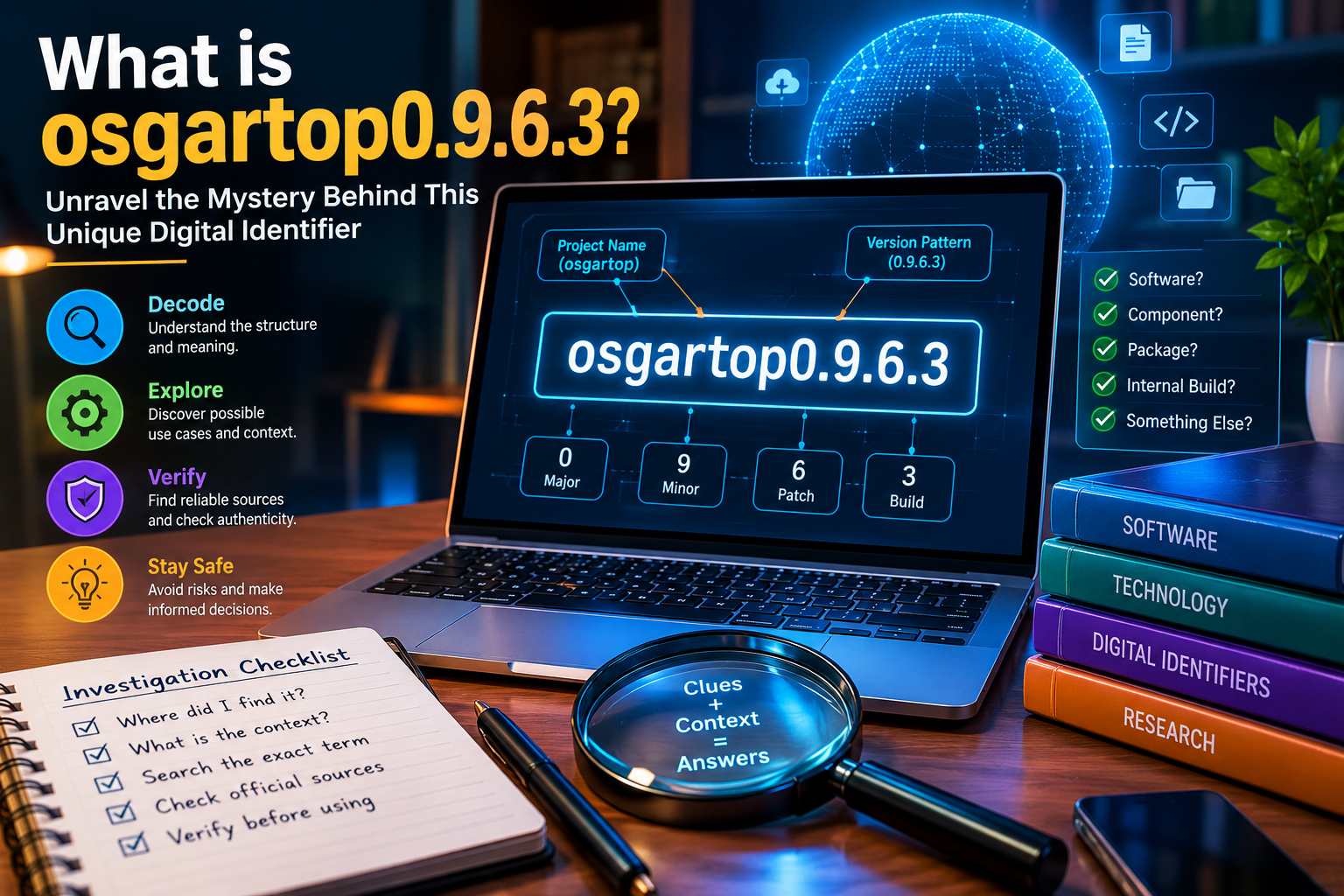
Digital environments are full of names that look confusing at first glance. A technical string may appear in a software directory, configuration file, log entry, documentation page, or online discussion without explaining what it means. One example that can attract attention is what is osgartop0.9.6.3. The unusual combination of letters, numbers, and version-like segments makes it look important, but a name alone does not reveal its exact function.
This guide takes a fresh approach. Instead of assuming that every unusual identifier is a known application or framework, it examines the clues inside the name, explains how software identifiers are commonly structured, and shows how readers can investigate unfamiliar technical terms safely. If you have searched for what is osgartop0.9.6.3, the goal here is to give you a practical method for understanding it without relying on unsupported assumptions.
1. Start With the Question, Not the Assumption
When someone asks what is osgartop0.9.6.3, the first mistake is to decide immediately that the string must be a particular product. Technical identifiers can be many things: a package name, release label, internal component, build reference, configuration value, project identifier, or versioned software term.
A better starting point is evidence. Ask where the term appeared, what words were next to it, and whether a reliable source explains it. These clues are often more useful than the identifier itself.
The question what is osgartop0.9.6.3 should therefore be treated as an investigation rather than a simple definition request. That approach is especially useful when search results provide different descriptions or when the term has limited documentation.
2. Read the Identifier as a Pattern
The next clue comes from the structure. The beginning, “osgartop,” resembles a project, product, module, or namespace-style name. The ending, “0.9.6.3,” resembles a multi-part version sequence.
This does not prove what the software is. However, it gives us a useful hypothesis. Software projects often attach numerical releases to names so developers can distinguish one build or revision from another.
In practical terms, what is osgartop0.9.6.3 can be approached as a combined name-and-version pattern. The exact meaning of each number should still be confirmed through documentation instead of guessed from the digits.
3. Why Version Numbers Matter
Version numbers help technical teams track change. Depending on the project, a sequence can identify a major release, minor update, patch, build, revision, or another internal stage.
A sequence such as 0.9.6.3 should not automatically be interpreted using one universal rule. Different developers use different versioning systems. Some follow semantic versioning closely, while others add build or revision numbers.
That is why what is osgartop0.9.6.3 cannot be answered accurately by reading only the numbers. The sequence provides clues, not a complete technical specification.
4. Could It Be a Software Component?
One reasonable possibility is that the identifier belongs to software or a software component. It may be associated with a framework, utility, package, backend component, development project, or another digital system.
But possibility is not proof. A responsible technical explanation should separate confirmed information from interpretation. If a primary project page, official repository, package registry, or developer document identifies the term, that source should take priority.
When researching what is osgartop0.9.6.3, look for an original publisher or maintainer rather than depending entirely on copied articles. Primary evidence can clarify whether the name refers to a complete application, a library, a release, or something more specialized.
5. The Context Test
Context is one of the strongest tools for decoding an unfamiliar identifier. Imagine seeing the term in five different places:
- A software installation folder
- A server log
- A developer repository
- A configuration file
- A general technology article
The meaning could be different in each setting. A folder name may indicate a component. A log entry may identify a build. A repository may reveal a project. A configuration file may contain a package or service reference.
For anyone researching what is osgartop0.9.6.3, recording the exact location where it appeared can save considerable time. Context turns an isolated string into an identifiable technical clue.
Read more: 30.6df496–j261x5: 7 Powerful Ways to Understand This Unusual Digital Code
6. Do Not Confuse a Version With a Product
A common SEO and technology-writing mistake is to treat a version label as though it were automatically the name of a complete product. In reality, version strings often belong to smaller components.
For example, a project might contain several packages, plugins, services, or modules, each with its own release identifier. A version-like suffix can therefore describe one part of a larger ecosystem.
This distinction matters when evaluating what is osgartop0.9.6.3. The identifier may represent a release state rather than a standalone application. Until reliable documentation confirms otherwise, readers should keep both possibilities open.
7. What Can You Learn From Search Results?
Search engines can be useful, but they are not automatically authoritative. An unusual technical term may produce pages that repeat one another without providing original evidence.
When reviewing results for what is osgartop0.9.6.3, compare several signals:
- Is the page published by the project owner?
- Does it provide technical documentation?
- Does it show a repository or package source?
- Does it identify the version history?
- Do independent sources agree?
- Is the information recent enough for the software involved?
If multiple pages repeat the same claim but none links to primary documentation, treat that claim cautiously.
8. A Better Way to Verify the Identity
Verification does not need to be complicated. Start with the exact spelling. Then search the complete identifier in quotation marks. After that, try the name without the version suffix. Finally, search likely technical locations such as official documentation, source repositories, package indexes, and release notes.
For what is osgartop0.9.6.3, this process can reveal whether the full string is documented as a release or whether the name and version are being combined by third-party pages.
The most useful evidence is usually specific. A document that says exactly what the identifier represents is much stronger than a page that merely describes it using broad technology terms.
9. Security Should Be Part of the Investigation
Unfamiliar software names deserve reasonable caution. That does not mean an unusual identifier is malicious. It simply means users should avoid installing unknown files or executing commands before they understand the source.
If what is osgartop0.9.6.3 appears in a file or system environment, check the surrounding directory, publisher information, digital signature where available, installation history, and related documentation. Security software can also provide another layer of review.
Never download an unknown executable solely because a search result says it is necessary. Verification should come before installation.
10. How Developers Might Encounter It
Developers often meet unfamiliar identifiers through dependency files, build systems, logs, deployment tools, source repositories, or package managers. In those environments, a versioned string may be meaningful even if it is not a consumer-facing product name.
If what is osgartop0.9.6.3 appears inside a dependency list, the next step is to identify the package manager and inspect the package metadata. If it appears in a build log, look for the command or component that generated the entry.
This method is more reliable than searching the identifier in isolation because developer tools provide surrounding metadata.
11. How General Users Might Encounter It
A non-developer could see a technical identifier in an error message, browser page, software report, support article, or copied system information. In such cases, the goal is usually not to understand every technical detail.
Instead, ask three simple questions: Where did the identifier appear? What action caused it to appear? Does the source explain what it belongs to?
For users searching what is osgartop0.9.6.3 after seeing it unexpectedly, these questions can narrow the investigation quickly and reduce unnecessary concern.
12. The Difference Between Evidence and Description
A page may describe a mysterious identifier as a “powerful framework,” “backend system,” “utility,” or “digital toolkit.” Such descriptions can sound convincing, but they are still claims unless supported by documentation.
This is particularly important for what is osgartop0.9.6.3 because unfamiliar names can be easy to describe broadly. A careful article should avoid turning speculation into fact.
Look for concrete evidence such as source code, official release notes, package metadata, documentation, maintainer information, or reproducible technical references.
13. What the Identifier Does Not Tell You
The name alone does not reliably tell you:
- Who created it
- Whether it is commercial or open source
- Whether it is safe
- What operating systems it supports
- Whether it is actively maintained
- What programming language it uses
- Whether it is a complete application or a component
- What every number in the version means
This is an important lesson when researching what is osgartop0.9.6.3. A technical-looking string can contain useful clues while still leaving major questions unanswered.
A Practical Investigation Workflow
Here is a simple workflow anyone can use.
Step 1: Capture the Exact String
Copy the identifier exactly. Small differences in punctuation, capitalization, or numbering can lead to completely different results.
Step 2: Record the Source
Write down where you found it. A website, application folder, log, repository, or configuration file each provides different context.
Step 3: Separate Name and Version
Test the base name separately from the numerical suffix. This can reveal whether the version belongs to a known project.
Step 4: Search for Primary Evidence
Prioritize official documentation, repositories, package registries, and release records.
Step 5: Compare Independent Sources
Do not rely on one page when the identifier is obscure. Compare descriptions and check whether they point back to the same original source.
Step 6: Check Security Before Running Anything
If the identifier is connected to a downloadable file or command, verify the publisher and source before executing it.
Step 7: Keep Uncertainty Explicit
If the evidence does not establish a definitive identity, say so. Good technical research is allowed to end with “the available evidence is inconclusive.”
Common Mistakes to Avoid
One mistake is assuming that every version number follows semantic versioning. Another is treating search-engine snippets as documentation. A third is downloading software simply because a page associates it with the identifier.
People researching what is osgartop0.9.6.3 should also avoid copying descriptions from low-quality pages without checking their sources. Repetition does not automatically create credibility.
Finally, do not assume that an unfamiliar name is dangerous simply because it looks strange. The correct response is verification, not panic.
Read more: Exploring the Magic of the Maldives Paradise
Why a Cautious Explanation Is More Useful
Technical content is most valuable when it distinguishes facts from possibilities. If an identifier has limited authoritative documentation, saying that openly is better than inventing a detailed origin story.
For what is osgartop0.9.6.3, a cautious approach allows readers to understand the visible clues while recognizing the limits of those clues. It also gives them a repeatable method for finding stronger evidence.
That method remains useful even if the identifier later turns out to be a package, framework component, internal build, or another type of software reference. It also gives readers a clear standard for evaluating future searches for what is osgartop0.9.6.3.
Frequently Asked Questions
Is what is osgartop0.9.6.3 a software name?
It may be a software-related identifier or a version-style reference, but the exact identity should be confirmed through reliable primary documentation.
Is what is osgartop0.9.6.3 a version number?
The ending “0.9.6.3” has the appearance of a version or build sequence. However, its precise meaning depends on the project that uses it.
Is what is osgartop0.9.6.3 dangerous?
The identifier alone does not establish that something is dangerous. If it is connected to an unknown executable, download, or command, verify the source before running it.
Where can I investigate what is osgartop0.9.6.3?
Start with the exact string, then investigate the base name, official documentation, source repositories, package registries, and release information.
Why does what is osgartop0.9.6.3 look unusual?
It combines an uncommon name with a multi-part numerical sequence. That makes it visually similar to a software project and release identifier, even though the exact meaning requires evidence.
Can what is osgartop0.9.6.3 be an internal component?
Yes, that is one possibility. Organizations and software projects often use internal identifiers that are not widely documented publicly.
Should I install something related to what is osgartop0.9.6.3?
Do not install unknown software merely because the identifier appears in a search result. Confirm the publisher, source, purpose, and security information first.
Final Takeaway
For readers asking what is osgartop0.9.6.3, the strongest answer begins with evidence rather than assumptions. What is osgartop0.9.6.3 may eventually be identified through a primary source, but what is osgartop0.9.6.3 should not be defined solely by a search snippet.
The most useful answer to what is osgartop0.9.6.3 is not a confident guess; it is a method for establishing what the identifier actually represents. Its name looks software-related, and its numerical ending resembles a release or build sequence, but those clues should be treated as starting points rather than proof.
If you encounter what is osgartop0.9.6.3, capture its context, separate the name from the version pattern, locate primary evidence, compare independent references, and check security before interacting with unknown files. This is also the safest way to approach what is osgartop0.9.6.3 when online descriptions disagree. In other words, what is osgartop0.9.6.3 should remain an evidence-based question until a trustworthy source provides a clear definition.
That approach produces a stronger technical understanding than simply repeating an unverified definition. It also makes what is osgartop0.9.6.3 easier to research because the investigation is based on context, documentation, and verification. More importantly, it gives you a reusable research framework for any unfamiliar digital identifier you may encounter in the future.
