
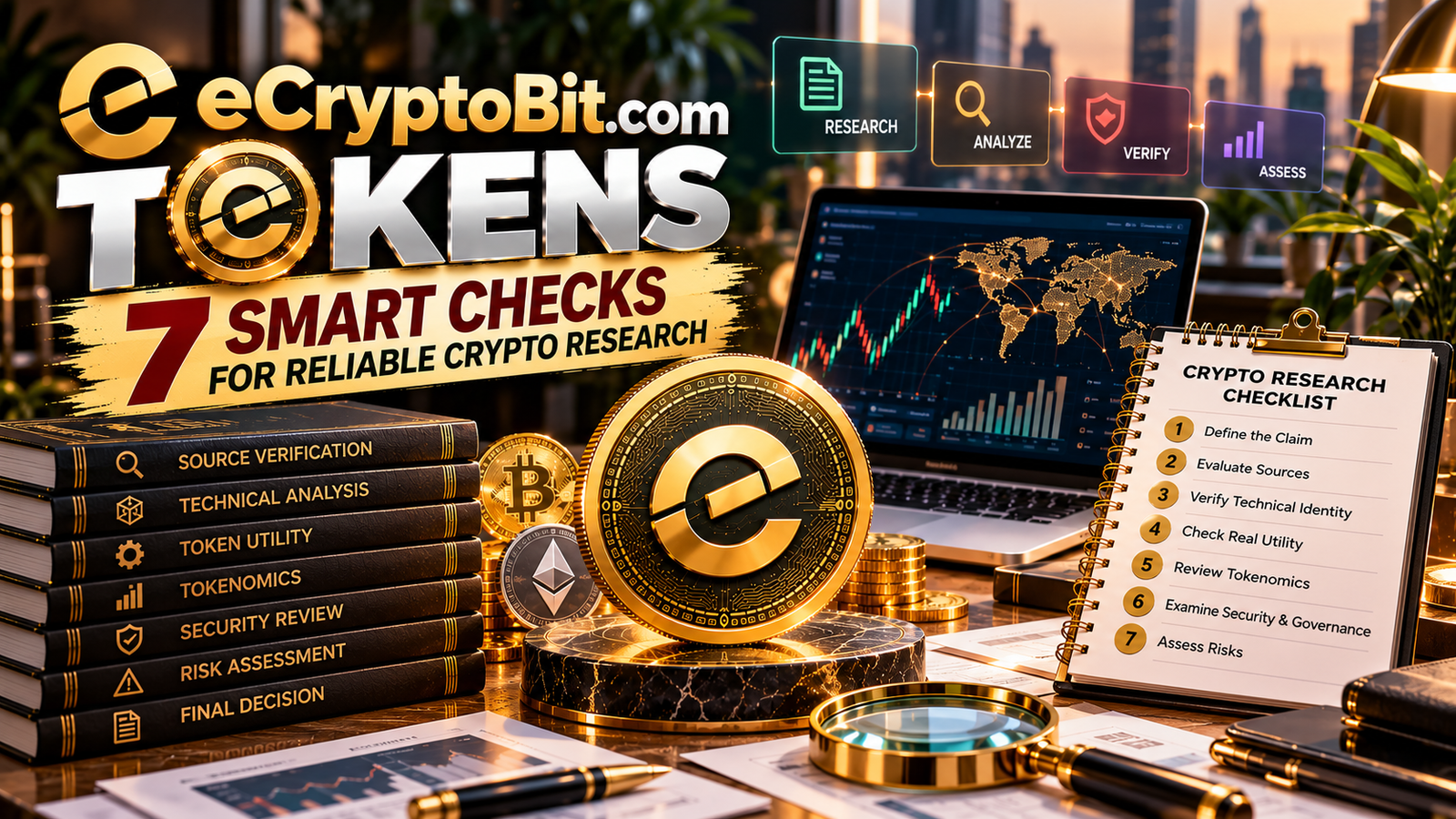
Cryptocurrency information is easy to find, but reliable evidence can be harder to identify. Websites publish explainers, projects announce new features, and social accounts share claims that may not be independently checked. Readers searching for ecryptobit.com tokens should begin by asking what the phrase refers to and what evidence supports any claim associated with it. A search term alone does not prove that a specific digital asset exists, has launched, or is connected to a particular website.
A cryptocurrency website may publish educational material without issuing its own token. This distinction is important when evaluating ecryptobit.com tokens. Likewise, a third-party article may repeat an assertion without confirming it. This guide offers a practical framework for investigating digital-asset claims, reviewing technical details, assessing utility, and recognizing risk. The aim is not to forecast prices or recommend an investment; it is to help readers distinguish documented facts from assumptions. This prevents unsupported assumptions from entering an analysis of ecryptobit.com tokens.
1. Define the Claim Before Researching It
Before researching ecryptobit.com tokens, identify the exact question you want to answer. Are you checking whether an asset has launched, whether it operates on a particular blockchain, whether it provides access to a service, or whether it is listed on an exchange? Each question requires different evidence.
Separate a website from a token issuer
A website can explain blockchain technology, wallets, smart contracts, and digital currencies without issuing a proprietary cryptocurrency. Do not assume that educational content confirms a native token. For ecryptobit.com tokens, look for a clear official statement that identifies the asset and explains its status.
Record the claim precisely
Write down the exact wording, the source, and the date. This record makes later reviews of ecryptobit.com tokens easier to audit. If a claim says that a token can be traded, for example, the relevant evidence should identify the asset and a verifiable trading venue. When researching ecryptobit.com tokens, do not replace missing information with guesses about prices, supply, or exchange availability.
The official eCryptoBit website is a starting point for reviewing what the site itself publishes. A general article about cryptocurrency is not, by itself, proof that the website issues a specific asset.
2. Grade the Quality of Your Sources
Good research separates direct evidence from repetition. Official announcements and technical documentation can show what an organization claims, while independent reporting may add context. Blockchain records can support certain technical facts, but they do not answer every question about a project.
When reviewing ecryptobit.com tokens, create a source log with the publisher, publication date, original link, evidence supplied, and any unanswered questions. This helps you avoid treating several copied articles as several independent confirmations. Apply the same source standard to claims about ecryptobit.com tokens.
Check freshness and context
An old roadmap may describe a feature that was never released. A listing announcement may no longer reflect current availability. Check whether the information is current and whether the wording describes a completed launch, a proposal, or a future plan. Use this approach whenever a new statement about ecryptobit.com tokens appears.
If a source discussing ecryptobit.com tokens does not link to primary documentation, treat its statements as claims rather than established facts. Missing evidence does not automatically prove misconduct; it simply limits what can responsibly be concluded.
3. Verify the Technical Identity
If a source claims that a token operates on a public blockchain, identify the network and find the complete contract address through a reliable source. A token name or ticker is not unique, and unrelated assets may use similar labels. This check is essential before treating ecryptobit.com tokens as an identifiable asset.
Use an explorer carefully
A blockchain explorer may show transactions, contract interactions, token holders, and whether source code has been published or verified. These records can help confirm technical details, but they do not guarantee that a project is honest, useful, or financially sustainable. Keep these technical limits in mind while reviewing ecryptobit.com tokens.
For ecryptobit.com tokens, compare the full address and network with primary documentation before assuming that an asset is officially associated with a website. A logo, screenshot, or similar name is not enough.
The Ethereum developer documentation explains blockchain fundamentals and smart contracts. The ERC-20 specification describes a common interface for fungible tokens on Ethereum. These sources explain general technology; they do not independently confirm a specific branded asset.
Read more: NVIDIA RTX Spark Laptops 2026: 7 Powerful Features
Understand the limits of on-chain data
A transaction record shows that activity occurred on a network, but it may not reveal the real-world identity of a wallet owner or the reason for a transfer. Some addresses belong to exchanges, custodians, contracts, or related project accounts. Technical evidence should be interpreted with context when evaluating ecryptobit.com tokens.
4. Test Whether the Utility Is Real
A credible description of a token should explain what a holder can do with it and why that function is useful. Broad promotional phrases do not establish a working use case. The same rule applies to every utility claim made about ecryptobit.com tokens.
Access and payments
Some tokens are designed to pay for a service or unlock features. Check whether the service is available, whether the token is actually required, and whether the terms explain fees or restrictions.
Governance and participation
Governance tokens may give holders voting rights over selected decisions. Their influence depends on the rules, the distribution of voting power, and how decisions are implemented. A label alone does not establish meaningful control.
Rewards and staking
Some projects offer staking or participation rewards. These arrangements can involve lock-up periods, changing rates, smart-contract vulnerabilities, and financial loss. Claims about ecryptobit.com tokens should not be described as confirmed features unless current documentation and observable evidence support them.
Treat these as general examples of token utility, not as claims that a particular website offers every feature. Verify each proposed function individually and note any conditions that could affect users.
5. Read Tokenomics Without Guessing
Tokenomics describes supply, distribution, issuance rules, and incentives. It can help explain how an asset is structured, but it cannot guarantee future price performance. Do not infer a financial outlook for ecryptobit.com tokens from general tokenomics examples.
Supply and circulation
Total supply and circulating supply may differ. Some projects reserve units for future release, while others permit additional issuance under defined rules. Supply figures can also vary depending on the source’s definitions and update schedule.
When researching ecryptobit.com tokens, do not publish specific supply numbers unless reliable documentation supports them. Record the source and date of every figure, and explain what the number measures.
Distribution and concentration
If a small number of wallets hold a large share of an asset, their activity may influence liquidity or market sentiment. However, wallet concentration needs context because some addresses represent exchanges, custodians, contracts, or treasuries. Concentration is a reason to investigate, not automatic proof of wrongdoing. Such context matters when interpreting any data presented about ecryptobit.com tokens.
Vesting and future releases
Token unlocks and future issuance can change the amount available in a market. Check official schedules and understand their conditions instead of guessing dates or percentages. If the underlying information for ecryptobit.com tokens is unavailable, say that the figures remain unverified.
6. Examine Security and Governance
Security involves more than a professional website design or a general statement that a project uses blockchain. Review technical assessments, administrative permissions, and decision-making arrangements. Apply these questions to any security statement concerning ecryptobit.com tokens.
Read audit reports in context
An audit applies to a defined scope and version. Check the date, findings, and limitations. An audit of one smart contract may not cover a website, wallet integration, administrator credentials, or later code changes. An audit can reduce uncertainty but cannot guarantee that a project is honest or financially viable.
Understand privileged permissions
Some contracts allow authorized accounts to pause activity, change parameters, or manage issuance. Such permissions may have legitimate purposes, but users should understand who controls them and how changes are governed. Claims about ecryptobit.com tokens should be tied to evidence about the specific contract, not broad statements about blockchain security.
Check governance transparency
Look for documentation explaining who can approve upgrades, change important rules, or resolve disputes. A project may describe itself as decentralized while leaving substantial control with a small group. The actual rules matter more than marketing labels. Record unresolved permission questions before drawing conclusions about ecryptobit.com tokens.
7. Make a Practical Risk Assessment
Cryptocurrency assets can be volatile, difficult to sell, and vulnerable to technical failures or fraud. Research should include the possibility of deciding not to proceed. These risk factors should be reviewed before taking action involving ecryptobit.com tokens.
Liquidity and exit conditions
A displayed price does not guarantee that an asset can be sold at that price. Low trading volume, withdrawal restrictions, network fees, and platform problems may affect an exit. Consider these factors before acting on claims about ecryptobit.com tokens.
Watch for misleading promises
Be cautious of guaranteed returns, urgent requests to invest, fake endorsements, or claims that losses are impossible. Popularity and positive comments do not prove that an offer is legitimate. For consumer guidance, consult the Federal Trade Commission’s cryptocurrency scam resources.
Protect wallet access
Never share a private key or recovery phrase with someone claiming to provide support. Check website addresses carefully, avoid suspicious links, and review transaction details before signing. Transfers to an incorrect address can be difficult or impossible to reverse. These precautions apply to ecryptobit.com tokens and other unfamiliar assets alike.
A Simple Research Worksheet
Before accepting a digital-asset claim, record seven things: the exact claim, the original source, the date, the evidence, the technical identifier if applicable, the main risks, and the details that remain unknown. This worksheet turns research into a repeatable process instead of a reaction to a headline. A dated worksheet can make future checks of ecryptobit.com tokens more consistent.
For ecryptobit.com tokens, keep confirmed facts separate from statements that still need verification. If important details are missing, the responsible conclusion is that the claim has not been verified. Waiting for better evidence is reasonable and can prevent avoidable mistakes. Readers should revisit claims about ecryptobit.com tokens when new primary evidence becomes available.
Read more: Mastering the Basics of 3D Texturing – A Complete Beginner’s Roadmap
Frequently Asked Questions
What does ecryptobit.com tokens refer to?
The phrase may refer to cryptocurrency educational content on the eCryptoBit website or to claims about a digital asset associated with that name. Its intended meaning should be established through official information.
Does eCryptoBit have a verified native token?
The information considered for this article does not clearly establish a native token with independently verified contract details and published tokenomics. Check current official documentation before making a definitive statement.
How can I verify a token contract?
Identify the blockchain network, obtain the complete contract address from a reliable source, and compare it with the appropriate explorer. A matching name or symbol is not sufficient proof.
Does a security audit guarantee safety?
No. An audit has a defined scope and date and may not cover every component or later change. It cannot eliminate all technical, financial, governance, or fraud risks.
Are staking rewards guaranteed?
No. Rewards may change and may involve lock-up periods, technical vulnerabilities, or financial losses. Review the terms carefully before participating.
What should beginners do if evidence is missing?
Do not treat missing information as proof that a claim is true. Compare credible sources, wait for verifiable documentation, and avoid risking money needed for essential expenses.
Conclusion: Let Evidence Guide the Decision
Reliable cryptocurrency research begins with a precise question and follows a consistent process. Trace claims to their sources, verify technical identifiers, test utility against real features, examine tokenomics, and consider security and liquidity risks.
The phrase ecryptobit.com tokens should not be treated as proof that a specific native asset exists or has a particular market value. Establish what the phrase refers to, verify the available evidence, and keep unsupported assumptions out of your conclusions. Careful research is more valuable than confident predictions. Ultimately, the evidence—not the wording of ecryptobit.com tokens in a search result—should guide the conclusion.
