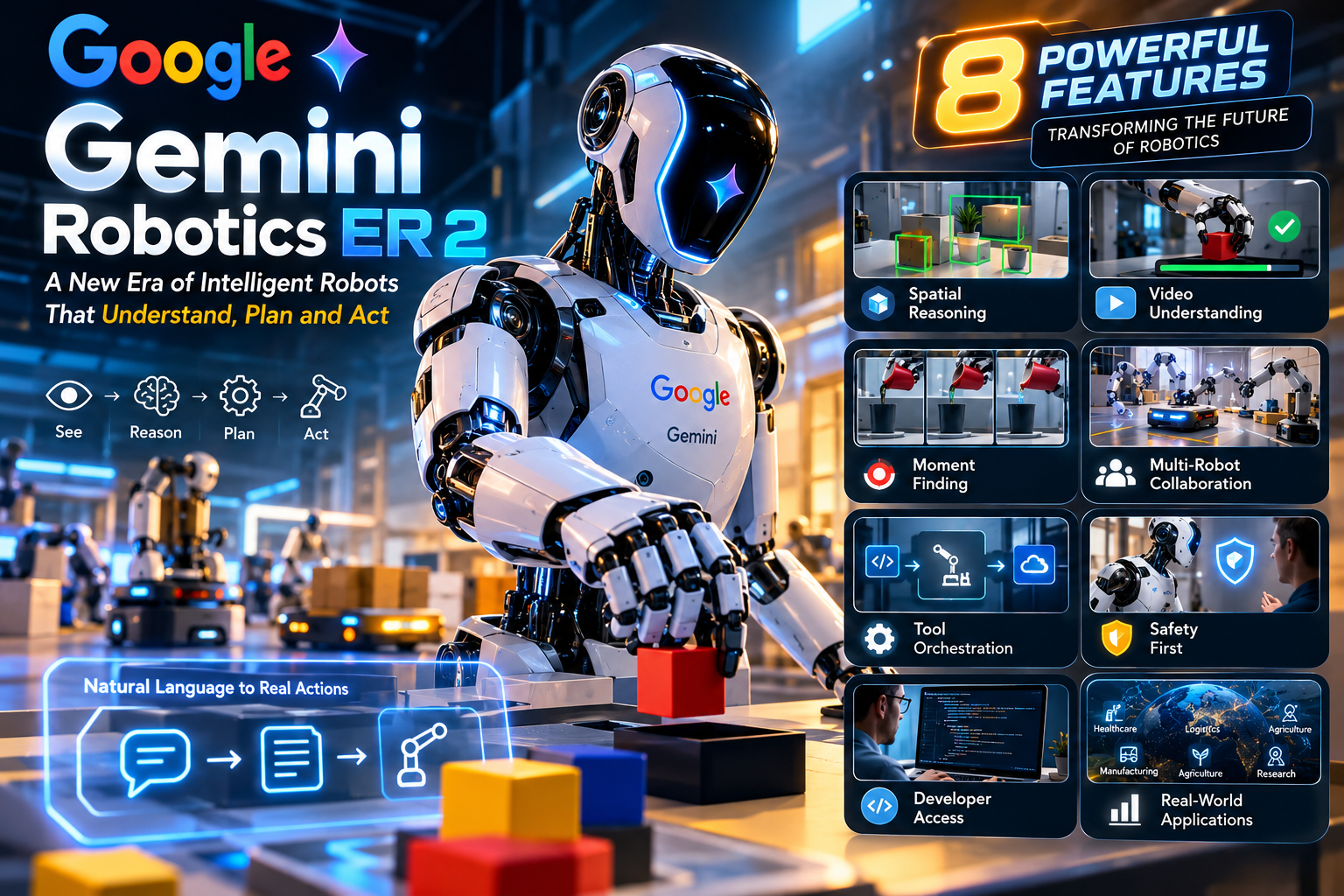
Artificial intelligence is moving beyond screens and entering physical environments. Robots are expected to recognize objects, understand instructions, plan activities and respond when conditions change. Google DeepMind is exploring this direction through embodied reasoning, and Google Gemini Robotics ER 2 is designed to help robots reason about the world around them.
The technology matters because recognizing an object is not the same as completing a task. A useful robot must understand where an object is, how it relates to nearby objects, what action is appropriate and whether the result was successful. Google Gemini Robotics ER 2 provides a high-level reasoning layer that can help developers connect perception, planning and robot tools.
This guide explains the model’s purpose, capabilities, potential applications, developer access and limitations. It also distinguishes reasoning from the lower-level systems that physically move a robot. For teams evaluating Google Gemini Robotics ER 2, the key question is how well its reasoning fits a real task. A useful way to assess Google Gemini Robotics ER 2 is to test it against clear, repeatable physical scenarios.
1. What Is Gemini Robotics ER 2?
ER stands for Embodied Reasoning. In robotics, embodied reasoning means understanding information about a physical environment and using it to plan suitable actions. A robot may receive an instruction, inspect a camera feed, identify relevant objects and decide which operation should happen next.
Google Gemini Robotics ER 2 is a vision-language model built for this type of reasoning. It can work with inputs such as text, images, video and audio, helping interpret tasks and coordinate tools. It is not a complete robot controller and does not independently provide every motor movement. Instead, it can act as a high-level intelligence layer that works with lower-level controllers and Vision-Language-Action systems.
For example, if a robot is asked to place a package on a shelf, the reasoning layer can help identify the package, locate the shelf and determine an appropriate sequence. A separate manipulation controller is still responsible for the precise physical movement.
This division of responsibility is important. Different robots have different grippers, sensors, movement systems and safety requirements. Google Gemini Robotics ER 2 can help coordinate the task while specialized components handle execution. Developers considering Google Gemini Robotics ER 2 should distinguish planning quality from movement accuracy. In practice, Google Gemini Robotics ER 2 is most useful when connected to reliable perception and control components. This makes Google Gemini Robotics ER 2 relevant to projects that need more than simple object detection.
2. Spatial Reasoning Helps Robots Understand Their Surroundings
Recognizing an object is only the first step. A robot also needs to understand where that object is, what is around it and how it relates to other objects. This is known as spatial reasoning.
Google Gemini Robotics ER 2 is designed to answer questions about visual scenes and interpret spatial relationships. Developers can build workflows that ask what objects are visible, where a target is located or whether one item is positioned near another. These abilities can support robots working in warehouses, laboratories, workshops and other structured environments.
Imagine a warehouse robot searching for a particular package among many similar boxes. It needs to identify the correct package, understand its location and coordinate with navigation software to reach it. In a laboratory, a robot may need to locate a particular instrument before starting a procedure.
Google has also described visual question-answering and instrument-reading capabilities. These can help interpret information from visual instruments such as dials, digital displays, rulers and thermometers. Google Gemini Robotics ER 2 therefore connects visual perception with task-level decisions rather than relying only on simple object labels. Teams can evaluate Google Gemini Robotics ER 2 by checking whether its spatial descriptions match the camera view. The value of Google Gemini Robotics ER 2 depends on how accurately the full system interprets the scene. Developers should test Google Gemini Robotics ER 2 with different object positions and lighting conditions.
3. Video Understanding Tracks Task Progress
A robot can perform a movement without actually completing the requested task. It might pick up an object but drop it, move a container but leave it in the wrong place, or begin an operation that is interrupted by an unexpected event.
For this reason, robotics systems need to observe actions over time and evaluate progress. Google describes video-understanding capabilities that can classify how far a task has progressed. Google Gemini Robotics ER 2 can help interpret changing visual situations and provide information that a surrounding application can use to decide whether to continue, retry or request assistance.
For example, a camera feed could be used to monitor whether a robot is assembling a component or sorting objects. Instead of treating every frame as an isolated picture, the system can consider how the activity changes over time.
These features may be useful in workflows where success depends on several actions rather than one movement. However, performance still needs to be tested with the actual camera setup, lighting, objects and working environment. This gives Google Gemini Robotics ER 2 a role in workflows where visual context changes during a task. For video-based applications, Google Gemini Robotics ER 2 should be tested on both successful and interrupted attempts. A careful evaluation can show where Google Gemini Robotics ER 2 identifies events correctly and where extra checks are needed.
Read more: about zarovviraf153: 9 Practical Ways to Investigate an Unknown Online Phrase
4. Moment Finding Can Identify Important Events
Some robotic tasks depend on recognizing one precise moment. A pouring action should stop when a container reaches the desired level. A robot placing an object should know when the object has reached its target position.
Moment finding is designed to identify a relevant point in a video. Google has reported 91.3% accuracy on its moment-finding evaluation and a mean absolute frame distance of 0.96 seconds. These are reported benchmark results, not a guarantee of performance in every physical environment.
Google Gemini Robotics ER 2 can help connect a visual event with a decision, such as moving to the next stage or stopping an action. Developers may explore this capability for inspection, sorting, pouring and assembly workflows.
Real deployments still require testing with the target hardware and environment. Camera placement, lighting, object variation and timing requirements can all affect performance. A robot should also have independent safeguards when an action must stop within a strict physical limit. In time-sensitive workflows, Google Gemini Robotics ER 2 should be paired with controllers that can enforce safe stopping. The orchestration capabilities of Google Gemini Robotics ER 2 may help teams coordinate tools across a larger process.
5. Multi-Robot Collaboration Supports Larger Workflows
Many workplaces use different types of robots because each machine is suited to a particular task. A wheeled robot may transport materials, a robotic arm may manipulate components and another system may inspect finished products.
The challenge is coordinating these machines so that work happens in the right order. Google Gemini Robotics ER 2 is designed to support orchestration across different robot tools and embodiments. A reasoning layer can help divide a larger request into smaller tasks and coordinate handoffs between available systems.
In a possible warehouse workflow, one robot could locate and transport a package while another handles a picking or sorting operation. In a factory, separate machines might move, assemble and inspect a component.
These are potential application patterns rather than a claim that every workflow is ready for commercial deployment. Each organization must connect the model to its own robots, APIs and operating procedures, then validate the complete workflow. Developers using Google Gemini Robotics ER 2 must define clear responsibilities for every connected robot. This approach could make Google Gemini Robotics ER 2 useful for multi-stage operations, provided each handoff is validated. With tool integration, Google Gemini Robotics ER 2 can help translate an instruction into a sequence of system calls.
6. Tool Orchestration Connects Reasoning With Robot Actions
Robotics development often involves many separate systems. A robot may rely on one component for visual perception, another for navigation, another for grasping and a separate controller for movement.
Tool orchestration allows a reasoning model to work with functions exposed by those systems. A developer can make suitable APIs or robot capabilities available as tools, then build a workflow in which the model selects the relevant function for a task. Google Gemini Robotics ER 2 is intended to support this kind of high-level coordination.
An operator might ask a robot to find an object and bring it to a workstation. The reasoning layer can interpret the instruction, identify the required object and coordinate with navigation and manipulation tools. The lower-level systems remain responsible for safe, accurate execution.
This approach may make robotics applications easier to adapt when tasks change or when several tools must work together. It does not eliminate the need for software integration, testing or robot-specific programming. The behavior of Google Gemini Robotics ER 2 should be logged so teams can review tool selection and task outcomes. Before production use, Google Gemini Robotics ER 2 needs evaluation against the organization’s operational requirements.
7. Safety Must Remain Central
AI systems that interact with physical machines introduce risks that ordinary software does not. A robot may operate near people, expensive equipment or fragile objects. A wrong action can cause damage or injury.
Google’s robotics research includes safety-related evaluation, such as following safety instructions and responding to human proximity. Google Gemini Robotics ER 2 can contribute to reasoning about safety instructions and visual situations, but it should not be treated as a replacement for physical safeguards.
A real deployment needs multiple protective layers. These may include emergency-stop buttons, movement limits, collision detection, restricted operating zones, supervision and careful testing. Organizations should also assess how a robot behaves when camera information is incomplete or the environment changes unexpectedly.
The complete robot system must be engineered and validated for its specific environment. Safety cannot depend on a single model response. Safety testing for Google Gemini Robotics ER 2 should include unusual situations and incomplete visual information. Human operators should remain able to supervise workflows involving Google Gemini Robotics ER 2.
8. Developer Access and Practical Evaluation
Google has made its robotics reasoning work available through developer tools, including the Gemini API and Google AI Studio. Google Cloud has also announced public-preview access through its Gemini platform. Availability, supported regions, model identifiers and pricing can change, so developers should consult current documentation before building a production workflow.
A typical development process may involve simulation, testing with sample tasks, connecting tools and evaluating performance before any physical deployment. Simulation can help teams identify issues before testing with real hardware.
Google Gemini Robotics ER 2 may be useful to researchers, robotics developers and businesses exploring physical AI. However, access to a model does not automatically provide a complete robot. Teams still need compatible hardware, control software, sensors, integration work and safety validation.
A practical starting point is a narrow task with measurable success criteria. Developers can test whether the model correctly interprets instructions, identifies relevant objects and selects appropriate tools before expanding to more complicated workflows. For researchers, Google Gemini Robotics ER 2 offers a platform for exploring embodied reasoning in practical settings. Businesses evaluating Google Gemini Robotics ER 2 should compare prototype performance with measurable baseline results.
9. Potential Applications Across Industries
Embodied reasoning could support a range of industries, although the results will depend on the robot platform, sensors, environment and quality of integration.
In manufacturing, robots may use visual reasoning to support assembly and inspection. In warehouses, systems could identify objects, help with sorting and coordinate transportation. Research laboratories may explore assistance with repetitive workflows, while agriculture could benefit from visual monitoring and task coordination.
Google Gemini Robotics ER 2 is a reasoning technology, not a ready-made robot for every industry. Each organization needs to evaluate whether the model fits its task, integrate it with appropriate hardware and measure performance in realistic conditions.
The strongest applications are likely to begin with clearly defined tasks where success can be measured. Teams can then expand gradually as reliability, safety and operational value become clearer. The developer experience around Google Gemini Robotics ER 2 will depend on documentation, API access and supported integrations. As the ecosystem develops, Google Gemini Robotics ER 2 may support increasingly complex physical AI experiments.
10. What Developers Should Consider Before Deployment
Before using a reasoning model in a physical environment, developers should define the task, identify the required sensors and determine which robot tools are available. They should also specify what counts as success, what conditions require a stop and when a human operator must take control.
Google Gemini Robotics ER 2 should be evaluated with representative examples rather than only ideal demonstrations. Testing should include unfamiliar object positions, poor lighting, partial camera views and unexpected interruptions. Logs and review processes can help teams understand why a system selected a particular tool or action.
Organizations should also review data handling, access permissions and cloud requirements. A successful prototype is not automatically a production-ready system. Hardware reliability, maintenance, cybersecurity and staff training remain essential parts of deployment. Overall, Google Gemini Robotics ER 2 illustrates how language-based reasoning can be connected to physical systems. For publishers and developers following physical AI, Google Gemini Robotics ER 2 is worth tracking as the technology matures.
Read more: The Importance of Sleep for Mental Wellness
Frequently Asked Questions
What does ER mean?
ER means Embodied Reasoning. It refers to reasoning about physical environments, objects, locations and actions.
Does the model directly control robot motors?
No. It provides high-level reasoning and orchestration. Lower-level controllers and compatible action models handle precise robot movements.
Can it understand video?
Yes. Video understanding can help analyze activities over time, classify task progress and identify important moments.
Can it work with different robots?
It is designed to support different robot embodiments through integrations and tools. Actual capabilities depend on compatible hardware and implementation.
Is it available to developers?
Google provides access through its developer ecosystem, including the Gemini API and Google AI Studio, and has announced public-preview availability through Google Cloud. Developers should check current official documentation for access details.
Conclusion: A More Intelligent Foundation for Robotics
Robotics is moving beyond fixed instructions and narrowly programmed movements. Future systems will need to interpret their surroundings, understand changing situations and coordinate several actions to complete a larger task.
Google’s embodied-reasoning approach brings together spatial understanding, video analysis, moment finding, tool orchestration and multi-robot coordination. These capabilities could help developers create more adaptable systems for factories, warehouses, laboratories and research environments. Google Gemini Robotics ER 2 is an important development to watch.
The technology is still evolving, and practical deployments will depend on hardware compatibility, safety engineering and real-world testing. For developers and businesses exploring physical AI, the most promising path is to begin with a focused task, measure the results and expand only when the complete system performs reliably.
